Image: Patrick Baldwin |
Central School of Ballet (London) is one of the world's leading ballet schools. Central was founded in 1982 by the late Christopher Gable CBE and Ann Stannard with the intention of offering students a very different experience of ballet training; namely, an education that would value individual and artistic expression alongside technique. Central has and continues to build close relationships with Japan. This year there are 15 Japanese students studying on the Foundation and BA (Hons) degree programmes.
This term, Central has welcomed Mr Ryota Kodera, who is completing his MA in choreography at Middlesex University, to work with a number of our current Japanese students on his independent project. Below, Mr Kodera summarizes his approach in creating his piece.
|
Classical ballet is a dance form that has been established amongst Western cultures. In recent years, I believe that the population of ballet dancers in Japan has increased and more and more Japanese people have begun to appreciate classical ballet. However, this development of classical ballet in Japan has not yet been enough to change Japanese people's perception of ballet - Classical ballet is still recognised as a foreign cultural activity. Getting rid of this "foreignness" without totally breaking the key aesthetic concepts of balletic conventions/principles is what I am trying to achieve in the project below
|
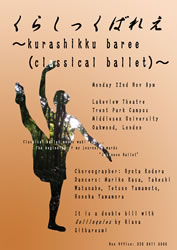
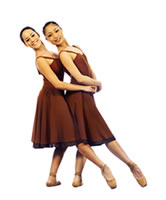
¤¯¤é¤·¤Ã¤¯¤Ð¤ì¤¨ - Kurashikku Baree (Classical ballet) is a ballet piece which was created by using the aesthetic principles of traditional Japanese art, such as sadoh (Tea ceremony), kadoh (Flower arrangement) and Kabuki. The piece also highlights some essences of wabi sabi (the Japanese theory of aesthetics that finds beauty in transience and imperfection). The dancers' movements embody the humble, tranquil nature of Japanese art and culture. Some sections are improvised by dancers so that they are able to release and share their internal feelings. Since ballet dancers (and especially Japanese ballet dancers, I think...) tend to be more used to moving according to the choreographers' directions, my dancers from Central School of Ballet found it rather challenging to bring out the movements of their own at the beginning of this project. However, they gradually became more relaxed and comfortable with physicalising the images they have created within themselves, which can then be conveyed to the audience. The beauty is not presented and ready to be served, the audience is there to search for it, sense it and become a part of it as well. What I looked for is not a representation of Japanese art in classical ballet, but it is rather the recontextualisation of classical ballet in Japanese terms.
|
|
Ever since Meiji Restoration (1868), the influences from Western cultures into Japan have been growing, and probably vice versa. Although my project is only a start, in today¡Çs globalised field of dance I believe that finding the point where Japanese culture and classical ballet truly meet is hard but not impossible. At least, this project is the beginning of my journey towards "Japanese ballet".
¤¯¤é¤·¤Ã¤¯¤Ð¤ì¤¨- Kurashikku Baree (Classical ballet) was performed on the 22nd November 2010 at Lakeview Theatre, Trent Park Campus, London. |
|