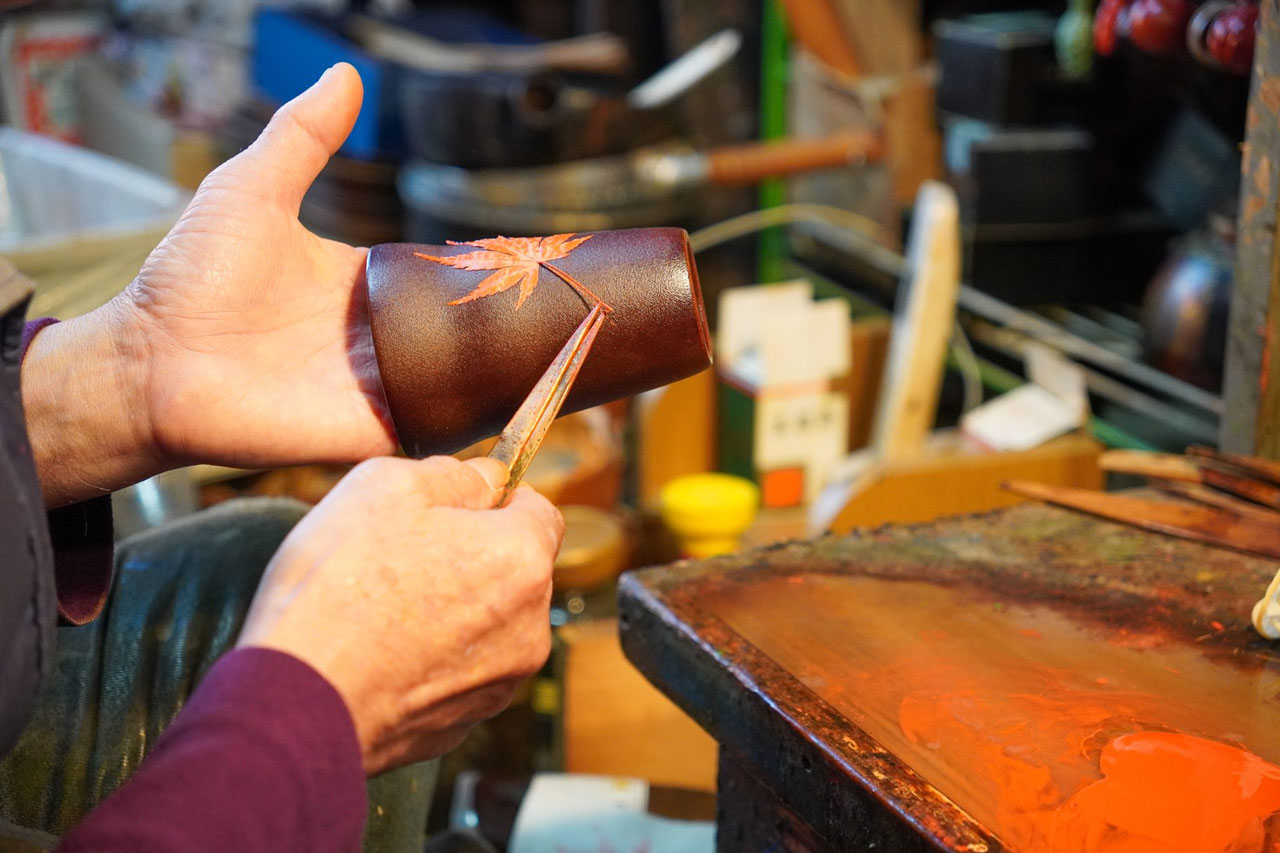
Image: Kaku Mitsuo of ‘Kaku Urushi Lacquer Ware’ (Kaku Shikki) decorating a urushi lacquer beer cup with Japanese maple leaves at his studio in Tokyo. © Clara Momoko Geber-Mérida.
East Asia Seminar – Evolving Traditions in Japan’s Contemporary Crafts: Shifts in Design, Gender, and Target Group
- 16 February 2026
- 5:00pm - 6:00pm GMT
- Faculty of Asian and Middle Eastern Studies, University of Cambridge, Room 8&9
- https://www.sainsbury-institute.org/events/east-asia-seminar-evolving-traditions-in-japans-contemporary-crafts-shifts-in-design-gender-and-target-group/
- +44 01603 597507
- sisjac@sainsbury-institute.org
- Tweet
Dr Clara Momoko Geber-Mérida, Robert and Lisa Sainsbury Fellow 2025-26, will be giving an in-person talk on Monday 16 February as part of the East Asia Seminar at the Faculty of Asian and Middle Eastern Studies, University of Cambridge.
About the Talk
Over the past decades, the traditional craft industry in Japan has been steadily in decline – both in its number of craftspeople, as well as in its production value. In truth, since the blossoming of traditional craftsmanship (dentō kōgei) during Tokugawa Shogunate’s rule over Japan (1603–1868) and its short-lived boom during the ‘economic miracle’ (1955–1975), the industry has always been struggling. Today, being a craft professional (shokunin) means to be working in a world that is, according to the craftspeople, ‘incredibly difficult to survive in’ and being able to ‘endure being in poverty,’ as there are fewer customers who value handmade objects. The rule-givers in this realm are merciless: Modern consumerism and capitalism – as reflected in changing tastes and the preference for mass-manufactured goods. Rethinking the industry of traditional crafts has become necessary to guarantee its survival. Those changes are already materializing in three ways: Innovative designs, a gender shift of the main actors, and new target groups. This talk investigates the changing field of traditional crafts by raising examples from various disciplines (metal hammering, woodblock printing, folding fans, amongst others), governmental support measures, and personal insights from craftspeople working in Japan.