From the Imperial Court to the present day : Tea demonstration and workshop with tasting by Hayami School of Tea
- 17 February 2026
- 15:30 - 16:45, 18:30 - 19:45
- The Hall, Japan House London, 101-111 Kensington High Street, London, W8 5SA
- https://www.japanhouselondon.uk/whats-on/from-the-imperial-court-to-the-present-day/
- +44 (0)20 7932 7100
- info@japanhouselondon.uk
- Tweet
Discover the Japanese Way of Tea through demonstrations and hands-on workshops expertly led by members of the Hayami School of Tea.
This event offers a rare opportunity to experience firsthand the values and aesthetics of the Hayami School through a ryūrei (table-and-chair style) tea demonstration led by Hayami Sōen, 8th Generation Grand Master of the school. The demonstration follows a richly illustrated lecture exploring the matcha production process, including a live demonstration of grinding tea leaves into fine powder using stone mills to make matcha.
Later, participants will learn how to prepare a perfect bowl of matcha using a bamboo tea whisk (chasen), before enjoying a serving of rich, foamy tea accompanied by Japanese sweets (wagashi). The demonstrations and workshops also provide an opportunity to appreciate exceptional Japanese craftsmanship. The demonstration table andkiseto-style tea bowls have been specially created for this occasion by renowned Kyoto-based artisans Ōtani Fugen (woodwork) and Nakajima Mokusen (ceramics).
All demonstrations and workshops will be expertly led by Hayami Sōen, 8th Generation Grand Master of the Hayami School of Tea.
About the Way of Tea and the Hayami School of Tea:
The Japanese Way of Tea, or sadō, boasts a history of more than 400 years and continues to be practised in Japan and around the world. Numerous schools of tea are active today, each offering a distinctive interpretation of the tradition through its own rules, principles and original approach. Many of these schools trace their lineage to buke sadō, the style of tea developed during the Edo period (1603-1868) and shaped by the values, discipline and aesthetics of buke – the samurai class.
The Hayami School, however, draws from a different and earlier source. Long before tea culture gained popularity among the samurai, it was enjoyed by members of the imperial court and aristocracy as early as the 15th century. The Hayami School reaches back to these refined, elegant and sophisticated roots. It was founded by Hayami Sōtatsu, who rediscovered and revived these early practices in the late Edo period. His vision, endorsed by Emperor Kōkaku and members of the Imperial Family, became the foundation of the Hayami School of Tea and has been transmitted faithfully to the present day. Today, the Hayami School continues to thrive, offering regular practice sessions for beginners and experienced practitioners alike, as well as tea gatherings and special cultural events.
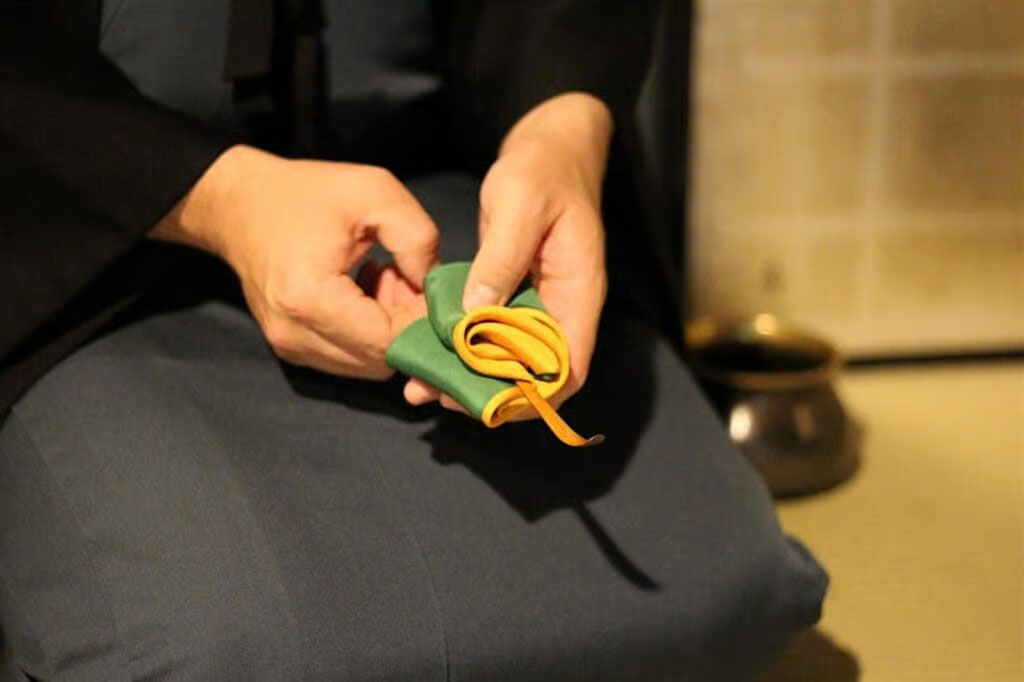
The image above shows a part of the tea ceremony when the chashaku (bamboo scoop) is symbolically cleansed with a fukusa cloth. The cloth’s opulent design is one of the distinctive aspects of the Hayami School.
About the speakers
HayamiSōen
8th Generation Grand Master, Hayami School of Tea
Hayami Sōen was born in 1983 in Kyoto as the eldest son of the 7th Grand Master, Hayami Sōgaku. At the age of six, he performed his first official tea preparation at Kitano Tenmangū Shrine. He studied Chinese literature at Bukkyō University in Kyoto while actively participating in tea-related cultural activities.
After graduating, he was appointed Assistant Director of the Hayami School of Tea and began teaching Tea in Tokyo. He has also served as a lecturer at Ōmihachiman City Museum in Shiga Prefecture and at Soai University in Osaka. In 2008, he entered the Buddhist priesthood and was appointed Young Grand Master of Shōgoin Monzeki Temple. Since assuming the title of 8th Generation Grand Master in 2019 and taking the tea name Sōen, he has continued to dedicate himself to education and cultural exchange through lectures and demonstrations in Japan and abroad.
Takeda Sōkei
Professor of Hayami School of Tea and the organizer of the event
Takeda Sōkei was born in 1951 in Kumamoto Prefecture. Her father was the headmaster of the Bunjin School of Ikebana in Kumamoto, and her mother was a professor of the Omotesenke School of Tea. She first studied Omotesenke Tea under her mother, later expanding her practice to Urasenke during her university years.
Upon encountering the Hayami School, she was drawn to its elegant manners and etiquette rooted in the culture of court nobility. She has studied in Germany and Korea and lived in New York, Frankfurt, London and Paris, where she actively organized cultural and charitable events, including initiatives supporting disaster-affected regions.
Other demonstrators:
The introduction to the matcha production process is conducted by Fujiki Sōen, Professor of the Hayami School of Tea, with the live demonstration of grinding tea leaves into matcha powder using a stone mill performed by Fujiki Seiya.
Tickets for the event are non-refundable. Please read our Terms and Conditions for Event Tickets beforepurchasingyour ticket.
Participants must be over 12years old to take part in thisevent.Children must be accompanied by an adult.
Please note that sweets served during the eventcontainthe following allergens:Egg, Wheat, Milk, Soya.
Please contact us online or call on +44 (0)20 3972 7100 if you are allergic to any of the above-mentioned ingredients.
Please note that filming and photography may take place at this event. Photos and footage of the event may then be used to promote Japan House London, helping more people to discover what we offer. If you have any concerns, please contact us online or contact a member of the team on site.
Booking essential | Admission £20
Please note that workshops are limited to 48 participants per session.
Attendees must be at least 12 years of age to participate in the workshop and any children must be accompanied by an adult.