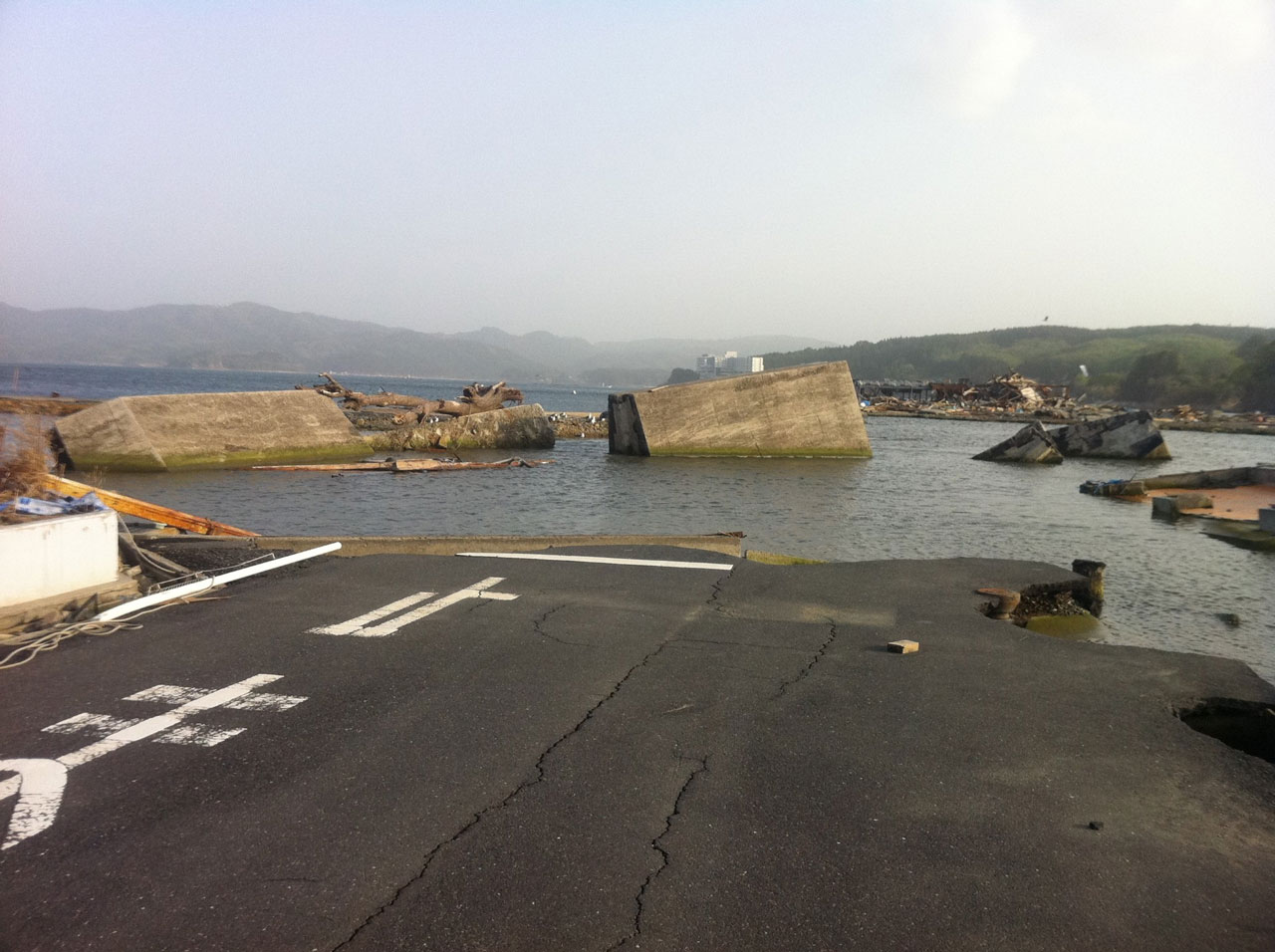
Image: Sanriku coast (Minamisanriku Town, NE Honshu) taken two months after the 2011 earthquake and tsunami, where the harbour was destroyed and parts of the land subsided below sea level as a result of the earthquake and tsunami. Photograph: Junzo Uchiyama.
Beyond Doom and Gloom: How Disasters, Survival, and Recovery Have Shaped Japanese Culture
- 19 March 2026
- 6:00pm - 7:00pm GMT
- Online
- https://www.sainsbury-institute.org/events/surviving-the-apocalypse-catastrophe-archaeology-in-ancient-japan/
- +44 01603 597507
- sisjac@sainsbury-institute.org
- Tweet
THIRD THURSDAY LECTURE - SAINSBURY INSTITUTE
Dr Junzo Uchiyama (Sainsbury Institute)
About the Talk
Recent disasters are often remembered as moments of sudden and total destruction—cities buried, societies erased, and lives swept away in an instant. Yet a longer view of human history reveals more complex stories, in which survival, adaptation, and recovery play central roles. How have people lived with repeated disasters over long periods of time? Did catastrophes bring only ruin, or did they also foster new forms of creativity, culture, and community?
This public lecture explores these questions through archaeology and history, using the Japanese archipelago as a long-term case study. Drawing on ongoing collaborative research within the Nordic–Japan research programme CALDERA, it examines how societies have responded to earthquakes, volcanic eruptions, and tsunamis across deep time. Marking the 15th anniversary of the 2011 Tōhoku earthquake and tsunami, the lecture focuses on three case studies: Mount Fuji and its long history of human engagement with volcanic risk; the Kikai-Akahoya super-eruption 7,300 years ago, which reshaped regional networks rather than causing total societal collapse; and the 2011 disaster, which prompted both profound loss and remarkable efforts at community rebuilding.
By placing these cases in comparative perspective, the lecture invites a broad audience to reflect on disasters not only as moments of tragedy, but also as forces that can reshape social networks, cultural practices, and future possibilities.
About the Speaker
Junzo Uchiyama was a former Handa Japanese Archaeology Fellow at SISJAC from 2018 to 2020. He is Affiliated Researcher of the Department of Archaeology and Ancient History at Lund University, Sweden, and Visiting Professor at Kanazawa University, Japan. Together with colleagues in Nordic countries and Japan, he launched a new research programme called “CALDERA” for “catastrophe archaeology” in 2021, aiming to investigate long-term cultural responses to major natural disasters and to understand processes of survival, adjustment and eventual recovery. In June 2024 he was awarded the Ben Cullen Prize for “outstanding contributions” to World Archaeology. In November 2024, the project “Surviving the Apocalypse: multidimensional modelling of the impact of a prehistoric megadisaster on people’s lifeworlds, technologies and demography” was approved and got funded by Swedish Research Council (VR), in which he is working as a co-project leader with Professor Peter D. Jordan at Lund University.