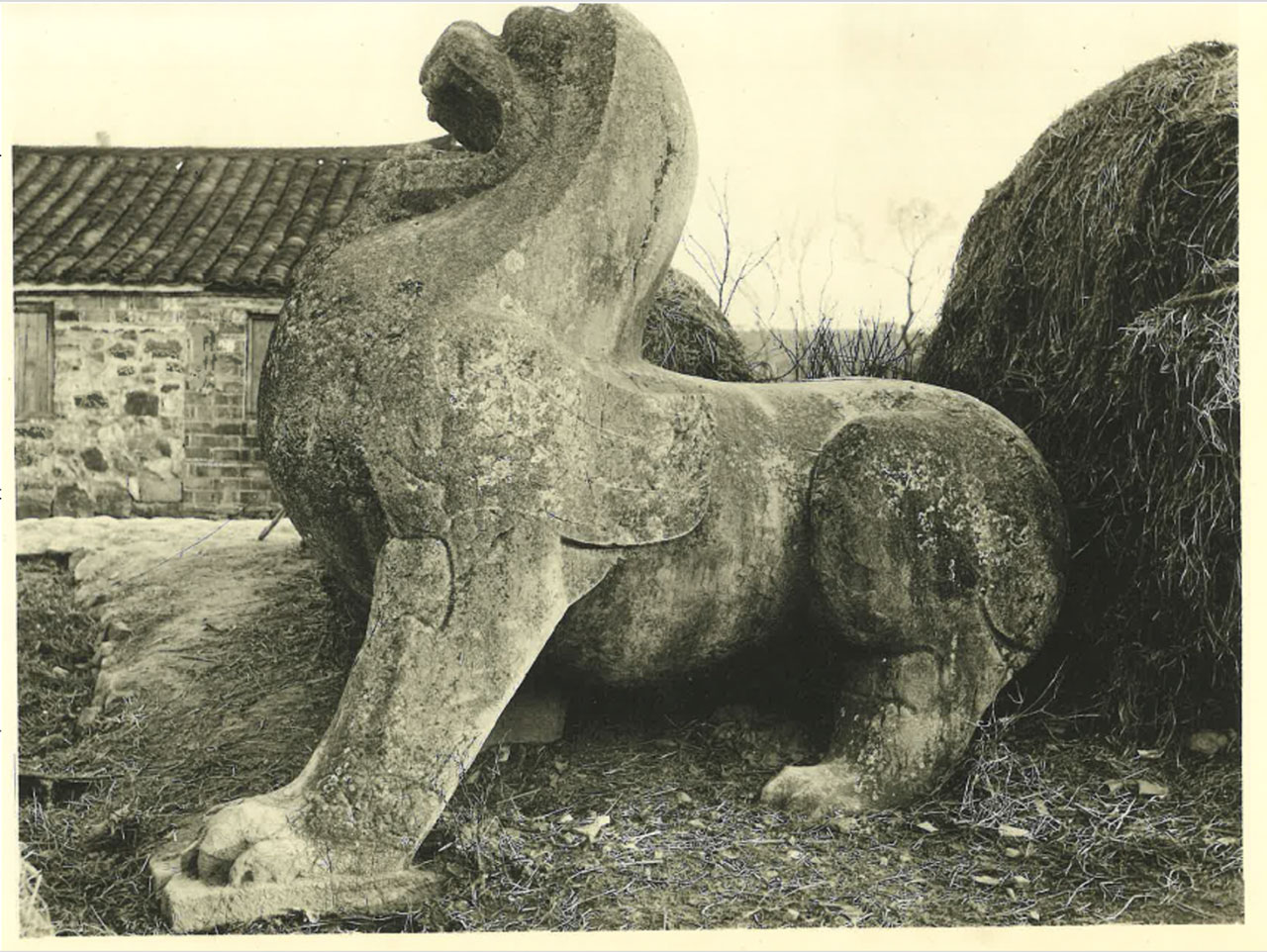
Image: Bixie statue of the Liang dynasty, as reproduced in Victor Segalen, Jean Lartigue, and Gilbert de Voisins, Mission archéologique en Chine (1914 et 1917), Atlas, vols. 1–2, La sculpture et les monuments funéraires: provinces du Chàn-ai et du Sseu-tch’ouan (Paris: Geuthner, 1923), plate LXXV
Japanese Colonial Calligraphy: The Case of Nishikawa Yasushi
- 21 April 2026
- 5:30pm BST - 7:00pm BST
- BG01, SOAS, Brunei Gallery Building
- https://www.sainsbury-institute.org/events/japanese-colonial-calligraphy-the-case-of-nishikawa-yasushi/
- +44 01603 597507
- sisjac@sainsbury-institute.org
- Tweet
Speaker
Professor Eugenia Bogdanova-Kummer (Sainsbury Institute)
About the Talk
Japan’s cultural appropriation of Chinese heritage during the politically charged 1930s was enabled by the interplay between calligraphy, archaeology, and photography. Focusing on Nishikawa Yasushi (1902–1989), a prominent Japanese calligrapher and modern literati artist, this talk introduces Nishikawa’s 1931 trip to Jiangnan and his encounter with the Liang-dynasty funerary complex. By situating Nishikawa’s experiences against the backdrop of the Japanese Empire’s militarist expansion, and introducing the concept of literati colonialism, I argue that the traditionally Sinophile Japanese literati’s insider knowledge facilitated Japan’s appropriation of Chinese cultural heritage, strengthening the country’s competitive edge vis-à-vis other colonial powers.
This lecture is part of the SOAS East Asian Research Seminar. It will take place at BG01, SOAS, Brunei Gallery Building.