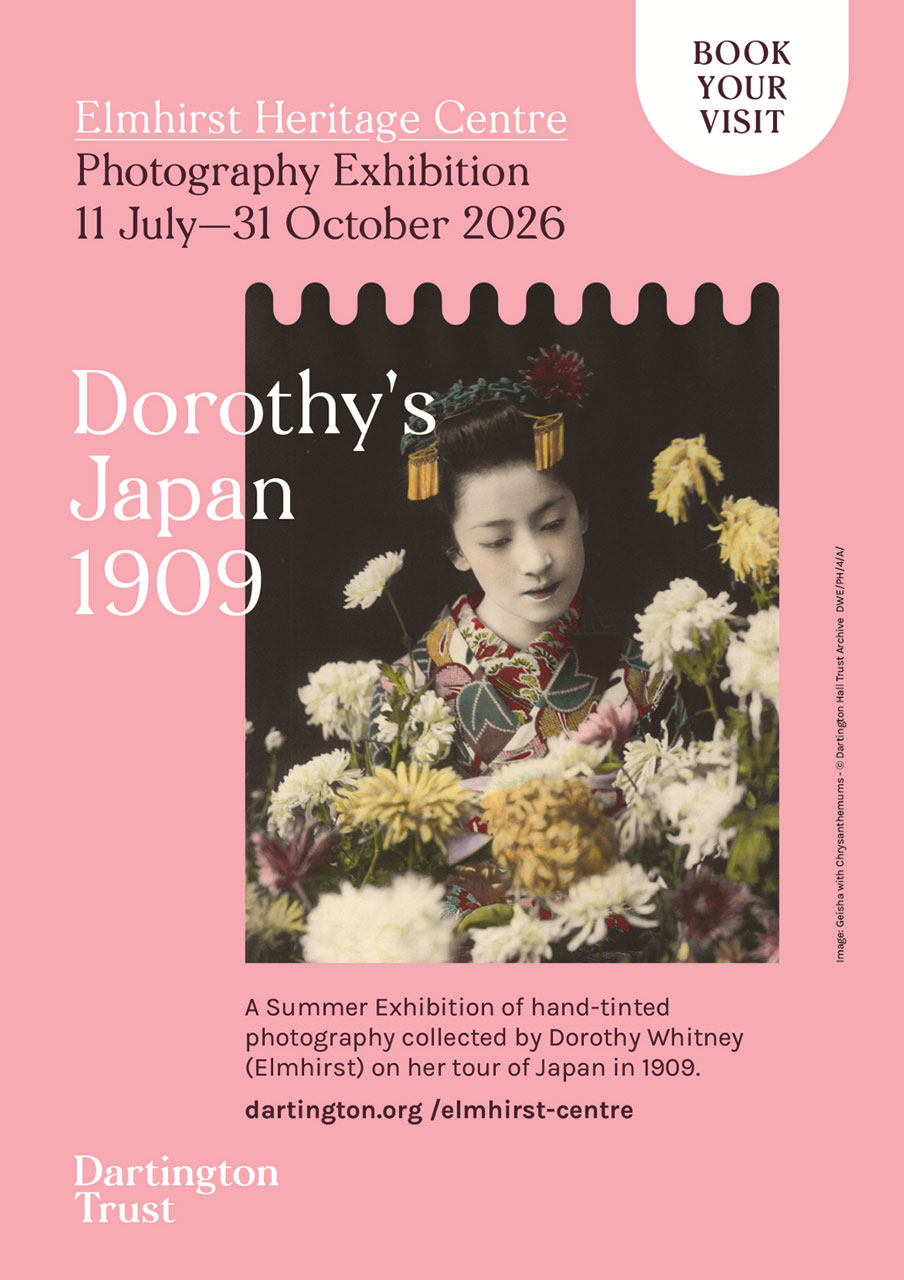
Dorothy’s Japan 1909
A Summer Exhibition of hand-tinted photography collected by Dorothy Whitney (Elmhirst) on her tour of Japan in 1909
- 11 July - 31 October 2026
- Tuesdays, 11am, 1pm, 2.30pm Thursdays, 11am, 2pm & Saturdays 11am, 1pm, 2.30pm
- The Elmhirst Heritage Centre, Dartington Hall, Totnes, Devon TQ9 6EL
- https://www.dartington.org/visit/elmhirst-centre
- 01803 874070 (Box Office)
- musem@dartington.org
- Tweet
This exhibition is the story of one small chapter in the extraordinary life of Dorothy Payne Whitney (Elmhirst).
A young heiress sets out
In 1909 Dorothy was just 22 and, having lost both her parents, had inherited a fortune. She had also met and enjoyed the company and conversation of a young man named Willard Straight. Fluent in Mandarin, he was about to be posted to Beijing (Peking) to help negotiate loan agreements with the Chinese government. In this very early stage of their courtship, he had offered to host Dorothy if she would like to visit him in China.
Planning a grand tour
Well Dorothy did much more. She began to plan a world tour for her small entourage of four intrepid women: Dorothy, her trusted friend Beatrice Bend, Beatrice’s mother Marianne Bend and Dorothy’s maid Louisa Weinstein.
They travelled across America in the Whitney family’s private railcar and boarded the SS Korea bound for Yokohama and Tokyo. The plan was to tour Japan’s famous Temples, Castles and beauty spots for the next two months before heading on to China to take up Willard’s invitation.
Japan opens to the West
For more than 200 years during the Tokugawa period, Japan tightly controlled its foreign contacts and trade. In a bizarre twist of family history, Dorothy’s great-uncle, Commodore Matthew Perry, had sailed the same waters in the mid-19th century. The threat of American naval power led to the 1854 Convention of Kanagawa and treaties opening up trade between Japan and the USA. Over the next decades Japanese society was transformed and there began a boom in western tourism.
A moment of cultural transformation
The timing of this small chapter in Dorothy’s life captured this sea-change in Japanese history. It also coincided with the exploding new art form of photography, which was challenging the more traditional art forms of calligraphy and ukiyo-e woodblock printing.
But in turn this was also an opportunity, seized upon by a group of artists whose traditional skills in calligraphy and ukiyo-e printing were now applied in a collision of the two art forms to create a new product for the newly burgeoning market of western tourism in Japan. A product that like the Kabuki (Theatre) and landscape woodblock art of the 18th and early 19th centuries offered up romantic, nostalgic visions of serene landscapes and beautiful Geisha.
A remarkable collection
Dorothy did not write down very much about her Japanese sojourn as her little party progressed from Tokyo and Kamakura, via Mount Fuji, to Nagoya, Kyoto, Kobe and onto the port of Shimonoseki, where Dorothy and her party sailed to China to meet Willard. But what she did do was collect a unique set of over 300 examples of this newly created art form. And in some cases, Dorothy pencilled notes on the reverse with interesting facts about Japan, its crops and flowers. These photographs have remained unseen and undamaged by sunlight in a secure box for a hundred and seventeen years.
Now we have digitised the best of these images for this stunning exhibition of hand-coloured tourist photographs from 1909 depicting this romanticised vision of a Japanese past.
How the prints were created
As Japan opened up to international tourism from the late 19th century, some Western and subsequently Japanese photographers began hiring artists skilled in calligraphy and painting ukiyo-e woodblock prints, which was in decline due to the growth of the new art form of photography.
From glass-plate negatives, black and white prints were mass-produced. But to fulfil the huge tourist demand for coloured prints, studios employed a production line of artists and each was allocated a single colour to hand-paint a specific part of the photograph. One applied blue to the skies, the next the pink of the cherry blossoms. As a result, the coloured images were replicated over and over. But each print also remained unique.
These artists worked with water-soluble pigments painting the black and white photographs with subtle translucent washes bound with the protein albumen from egg whites. This allowed details and contrast from the real image of the underlying photograph to remain distinct, creating the uniquely beautiful hand-tinted prints that became a defining characteristic of early 20th century Japanese tourist photography.
Admission :Full EHC Tour incl Dorothy’s Japan 1909 £12, Conc £10.50
Dorothy’s Japan 1909 Only £8 Conc £7