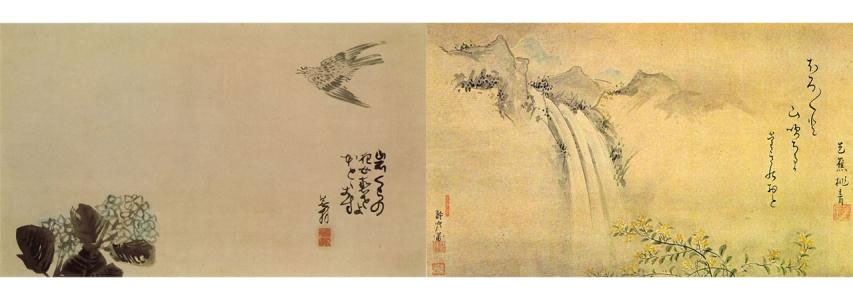
Image: Haiku by Yosa Buson reading "Iwakura’s / madwoman has fallen in love / the cuckoo", translated by Allan Persinger (left); Haiku by Matsuo Basho reading "Quietly, quietly, / yellow mountain roses fall – / sound of the rapids" , translated by Makoto Ueda (right).
From Japan to the World: The Global Journey of Haiku - with Robert Crawford
- 19 October 2026
- 6.45pm
- The Swedenborg Society, 20-21 Bloosbury Way (Hall entrance on Barter St), London, WC1A 2TH
- https://www.japansociety.org.uk/event?event=1183&eventcat=11
- +44 (0)20 3075 1996
- events@japansociety.org.uk
- Tweet
Haiku are now the world’s most widely-known poetic form. Yet until the end of the nineteenth century almost no one outside of Japan knew about them. Drawing on his new book, Haiku (Yale University Press, 2026), professor, poet and biographer Robert Crawford speaks about some of the most intriguing people – from a working-class London bookseller and a Japanese professor to a Mexican diplomat and an exiled African American – who helped to make this remarkable form of verse a global favourite. The lecture also suggests some reasons why haiku have appealed not only to some of the most celebrated modern writers but also to millions of people of all ages on every continent. It explains why they have continued to fascinate readers around the world in the era of Covid, and amid concerns about climate change, social media and the proliferation of AI.
Robert Crawford has published nine collections of poetry with Jonathan Cape, most recent of which is Old World (2025). His biographies include The Bard (2009),a life of Robert Burns, and an acclaimed two-volume life of T. S. Eliot comprising Young Eliot (2015) and Eliot after ‘The Waste Land’ (2022). Emeritus Wardlaw Professor of Poetry at the University of St Andrews, he is a Fellow of the Royal Society of Literature and a Fellow of the British Academy.
If you have any questions, please call The Japan Society office on 020 3075 1996 or email events@japansociety.org.uk.
Free- Booking essential